Showing posts with label unexpected churches. Show all posts

Monday, August 3, 2015

The Seychelles


We've been in honeymoon traps, including on our actual honeymoon, when Puerto Vallarta's slogan, "hey, honeymooners" made us feel perpetually foolish, a little defensive, and totally unwilling to purchase anything other than repeat tickets to the town's best veggie buffet (still unmatched in our vacation experience).

We admit that we expected that the Seychelles to be similar...beautiful, touristy, and lots of sappy marketing and over-sized, umbrella-laden drinks. ("Not that there's anything wrong with that," to quote Seinfeld.) We were wrong.


Not that there's anything wrong with being wrong.


We stayed on the main island, Mahe. Mahe is the most densely populated island; it's where the airport is, and where most locals live. And even Mahe is a sizeable chunk park: dense, lush, leafy, and jungly, with a few gorgeous hikes moseying around in it. Nick found one that meanders across cliffs and through forests to a secluded beach.


At least, it was secluded for us. We shared the beach with a few microscopic crabs (babies, perhaps?) and some bigger friends; in the water, we saw fan corals, brain corals, and hosts of neon-colored fish. As we meandered peacefully back, we discovered that the hike is best for early risers; we ran into dozens of people, including one local who heads out there to fish.

Further up, we found a trail wending through a mossy, almost Washingtonian forest, ending in this view. The Seychelles split off from India eons ago, and so it has mostly unique plant life, along with a few insects, birds, and reptiles that drifted or flew over from the mainland.


Unlike many jungly places, it is remarkably free of plants and animals that can kill you (and scientists are not sure why the Seychelles doesn't have malaria).  We spotted some snails, a wolf snake (harmless little brown guy), some huge spiders, and Nick claimed he got a bug bite....

....so we rewarded ourselves for our extreme bravery with roadside "takeaway," far and away the best beach food we've ever had: smoky fish mixed with shredded vegetables, tons of chillies, yellow dal, and rice.....


...for which it was necessary to scout out the best view.


But really, there were too many good views to prioritize properly. The island is completely ringed with gorgeous beaches.


Best of all (for two ghostly-pale people who miraculously avoid getting tan in Abu Dhabi, and who must therefore take care on vacation), the beaches are shady, an attribute we'd never even thought to look for on a beach. Sure, there are waifish palm trees, leaning out over impossibly clear water. But there is also good, serious shade.


We fell asleep on this beach, nestled into velvety sand, and woke up to a local urging us to choose a better spot: in addition to our shady trees, we were under a coconut palm, and in danger of being hit by falling coconuts. It's a tough life.

Apart from beaches and jungles, the island has towns, and the towns are messy and fun and full of interesting things. The Seychelles was uninhabited in the 17th century, when the English East India Company landed, and the island became a stopping point for ships trading in the Indian Ocean. Since then, the stake in the island rotated a little, but it wound up a British colony until 1976. This legacy is pretty visible: the island has several overgrown tea plantations (because where would the British legacy be without tea farming?).


Most locals are descendants of Indians, Africans (some from slave ships the English intercepted in the Indian Ocean), and Europeans. Many locals are gorgeous mixes of all three. The culture is, too. In Victoria, the tiny capital, we saw a mosque, three cathedrals, a Baha'i center, and a Hindu temple.


On the streets, there are croissants and baguettes for sale, alongside dals and dried fish and soft white snail-shaped breads that seem to be Seychelles originals. There are fresh fish laid out on wooden tables, ready to be chopped up with machetes and carried home. There are eggs, sold from the back of a truck; we carried ours home (as the locals were doing) loose in a plastic bag.

We grabbed a smoothie and a snail roll in Victoria, where the Natural History Museum is worth a visit (coral crabs!) and the art galleries are a delight. But mostly we enjoyed exploring the coast, stopping to go running and to explore each new wonder: beaches with velvet sand, plants with impossibly huge leaves, coral reefs, surprisingly patterned fish, and mountain vistas.


And we left from an airport that probably has the most gorgeous beach in the world. If only we could've waited for our flight out in the ocean.... 

Friday, December 12, 2014

Petra


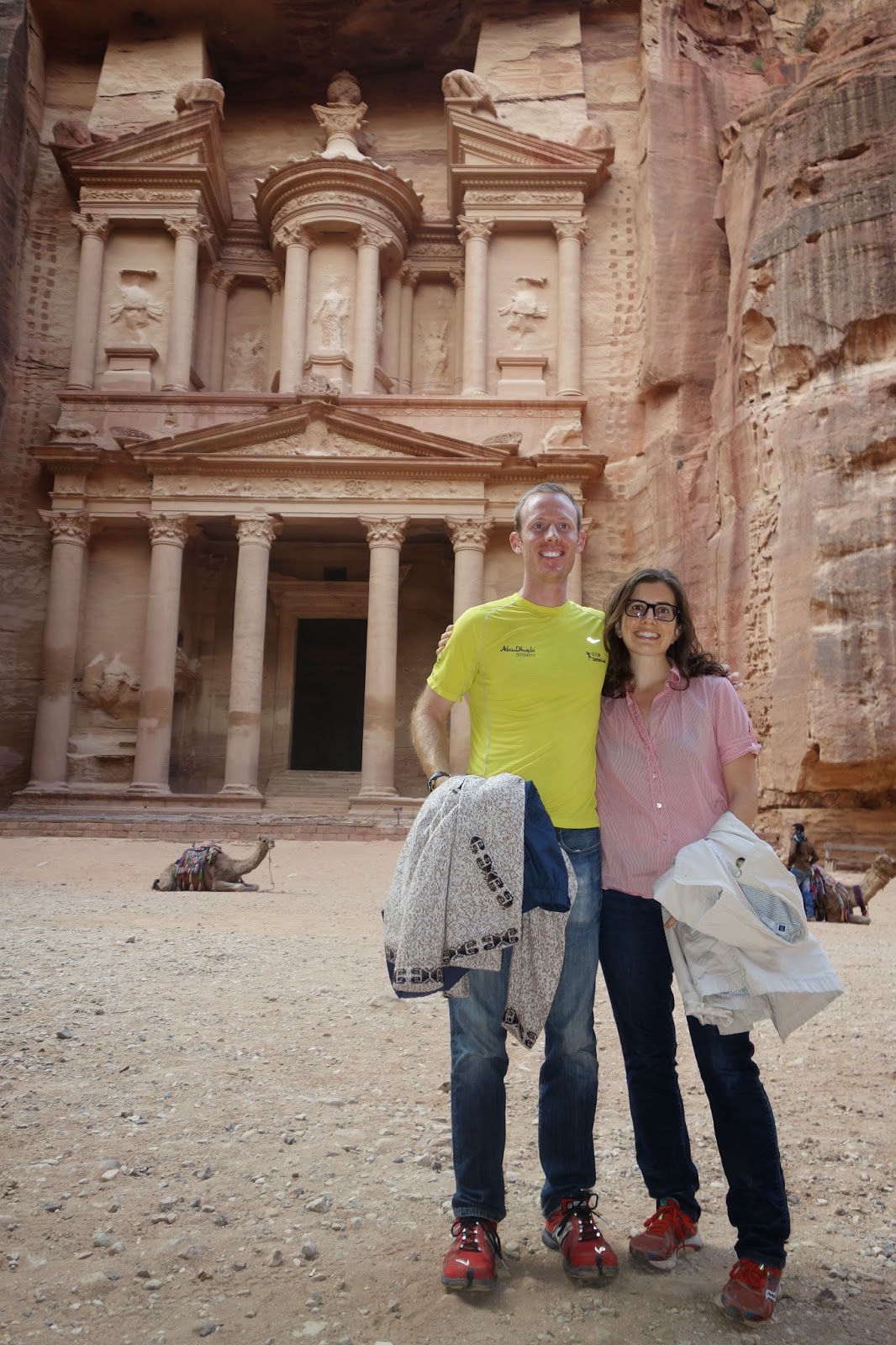
The most famous monument in Petra is the Treasury, where Indiana finds the holy grail.  If we were looking for the holy grail, that is where we would look too.  We would start underground -- there is an entire story which isn't visible in the picture.

The Nabateans built Petra around 300 BC, and were their peak from 100 BC to 100 AD before they were annexed by the Romans.  Petra is filled with incredible structures (mostly tombs) carved into rose-colored rocks.


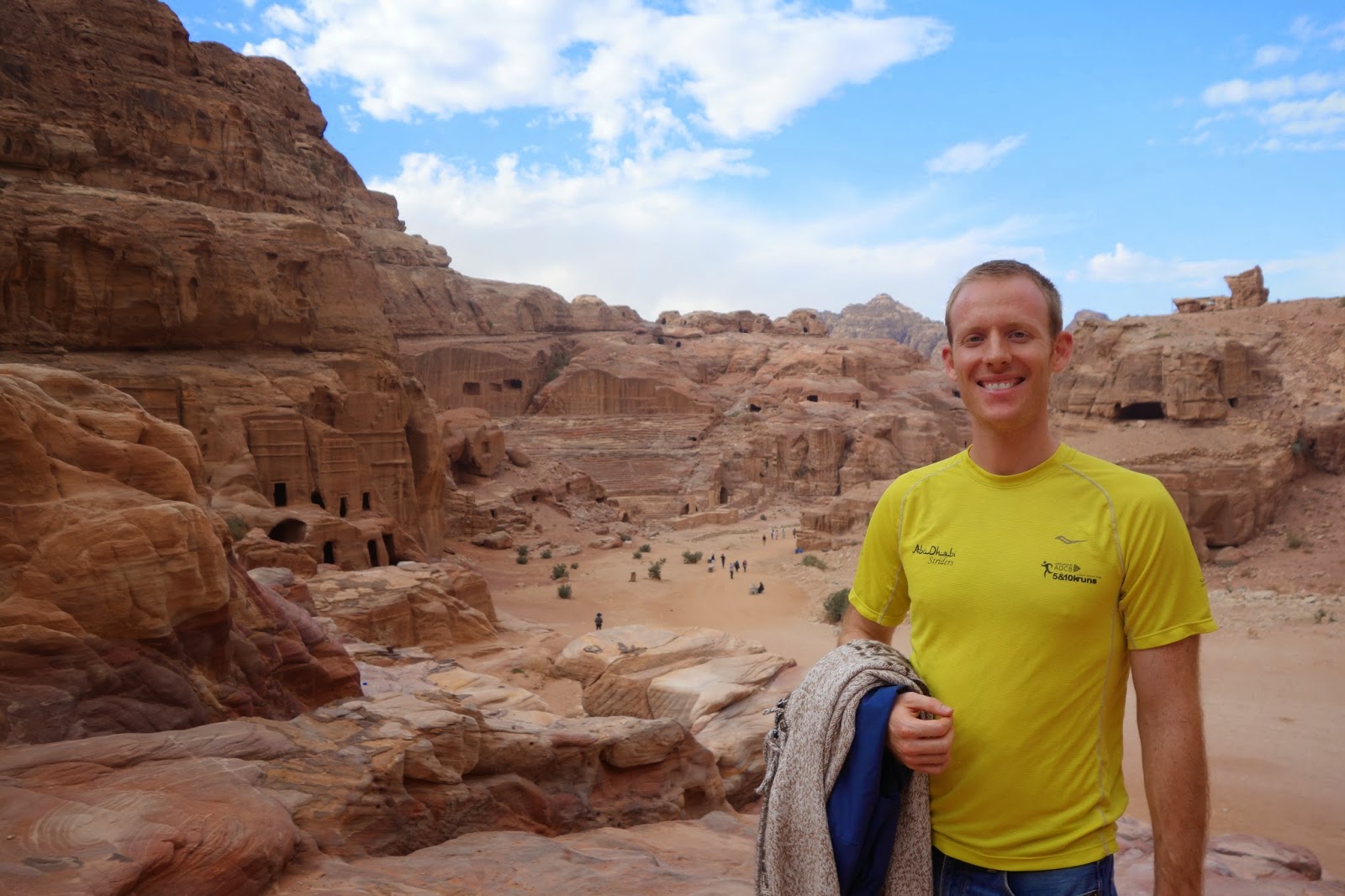
The Nabateans were incredibly wealthy -- and not very war-like -- and expected the Romans would be interested in taking them over.  They lavished the Romans with gold and other gifts, and must have built this theater to keep them entertained when they visited.

Besides the Treasury, the monastery is considered the most spectacular ruin in Petra.  It is a strenuous but beautiful hike from the main city (the biggest complaint about Petra is the number of stairs).
 
We weren't disappointed when we made it to the top.  It is hard to believe how big the buildings are.  Here is the monestary, with a tiny little head at the base as point of comparison.


The view on the way back down reminded us our trip to Utah.


The Byzantines made it to Petra, of course, and spent enough time to tile the floor of a church.
The land was beautiful, and must have been more so when it was a bit more lush.  But even when Petra was inhabited, it was very dry, and the Nabateans built an elaborate system to store water during flash floods.  The floods were enough to create an oasis and support agriculture during prolonged droughts. 


Later, we walked up to the High Place of Sacrifice, which the Nabateans thoughtfully situated where the sacrificed would have a great final view.

We spent parts of three days in Petra, which was enough time to see everything we wanted to see.  The final day we arrived as the park opened, and it felt like we had it to ourselves (other than the locals who live in / on the outskirts of Petra) for hours.

The King's Highway

The King's Highway is an ancient trade route from Egypt to Iran, and control of the road was source of many conflicts beginning in Biblical times.  Now anyone can drive on it with a Jordanian visa and a functional automobile.  We had some doubts about our vehicle -- the knobs on the window cranks fell off as soon as we got in the car -- but it was almost certainly more comfortable than taking a camel.


Along the way we stopped at Madaba, home to amazing Byzantine mosaics.


The Byzantines built several churches in Madaba, and Madaba now has the largest Christian population in Jordan.


The next stop on the King's Highway was a castle built by the crusaders built in the 12th century, and the largest such castle outside of Syria.  The castle was several stories -- the stables were three levels! -- and was very carefully organized to store and conserve water.  The kitchens were spread over several rooms, and they had enormous vats for pressing grapes into wine.  It must have been cozy in the winter, but no amount of wine would convince us to spend a sweltering summer in the castle.


Friday, October 31, 2014

A Passage to India, volume I: Chennai

We spent our first three days in India in Chennai, the bustling and sprawling capital of Tamil Nadu.


We were nowhere near EM Forster's sound-warping caves, but there were some Forster-worthy miscommunications. Our gracious hosts were so anxious for us to have a good time that we grew anxious that they were over-exerting themselves. Chief among mounting anxieties was the worry (no one will possibly believe this) that we weren't eating enough. They were especially worried (again, we don't expect you to believe this) about Nick.


Believe us, he was eating. For starters, he ate that, in one sitting! And it was amazing. In Chennai, we had the best chana masala, poori, and daal we'd ever tasted. Every day was full of delicious dishes, familiar and unfamiliar. Each and every one of them was rich and incredibly filling.

We had a brief respite from our marathon-like meals over coconut water...


...and while learning to cool hot coffee, Indian style.


On our first full day in Chennai, we wandered through "nearby" Pondicherry, the largest French colony in India. Pondicherry, we discovered is actually pretty distant from Chennai (which was a British trading post for cotton, widely known as Madras).

Pondi, as it's affectionately known, impressed us from the start. Upon getting out of the car, we turned to see an elephant amble down the middle of a street full of parked cars. Unfortunately, we only got pictures of Nick walking down the street. We'll pretend not to be disappointed.


The French quarter is pretty and quaint, with big trees arching over the road, brick-paved streets, and a pretty town square. Street names are all in French, as are the stations of the cross in this lovely Catholic church.


On the way to Pondi, we saw strange things. First example: Oreville, a Utopian town conceived in the 70s, built around meditation inside a golden bean, which apparently holds a large crystal. The town has been slow to spring up (as has the moat promised around the bean), but non-participants can view the bean from afar.


We imagine that more time was spent perfecting the bean than crafting the town's guidelines, which require town citizens to abandon religion, and also to "live freely" under a "single authority." Conduct a few interviews, and we could write the condescending New Yorker piece ourselves.

We also saw wondrous things. (No, the bean didn't really count.) Also on the way to Pondi was Mamallapuram, sprawling stone temples dating from 7th - 9th century.


The temples testified to the booming trade in the region -- we saw Roman columns and Chinese-style pagodas and lions.


This temple, which is one of the largest bas reliefs in the world, was our favorite -- covered in Hindu stories all carved from a single stone.


That little columned temple on the left shelters some rather darling animals. A bull stands strong, his leg jutting out from the rest of the carving.


A mama cleans her baby.


Krishna's Butterball is nearby. The huge stone worried the British so much that they had seven elephants try to dislodge it before it fell on its own.  The elephants couldn't budge it, and it remains perched not-so-precariously on the hill.


We were delighted, after such serious sightseeing so far afield, to spend time in Chennai. The streets are packed -- with cars, with people, with oxen, with food sellers. The bustle was dusty, vibrant, and exhausting. Temples make for a tiny bit of respite at nearly every street corner.


We visited Kapaleeshwarar on a Story Trails tour of Chennai. We were glad to get guidance. We had no idea, for example, that there is a set path through Hindu temples (we wondered in Nepal why we were the only people wandering back and forth), and we didn't realize that the chatting, back-slapping, and eating going on inside is part of usual temple life.


Mothers hoping to conceive, and girls hoping to get married, hang things from this tree. 


Catholicism made it to India early, with St. Thomas, who landed in Kerala and walked across the peninsula to Chennai, spreading the Gospel as he went. He lived in Chennai for some time, and was martyred on a nearby hillside. Today, St. Thomas's Basilica is built around his remains. 

The building is a neo-Gothic birthday cake of a church, ruffled and white. Inside and outside, local symbols and traditions blend with Catholicism. 

Mary graces the courtyard outside, wearing a sari. She gets a change of outfit (and, we hear, color) every day. 


Peacocks, symbols of purity, stand at the foot of the cross; Christ's feet rest on a lotus flower. Outside, flags celebrating the time of year and the religious day are draped on poles like those at Hindu temples.


The Portuguese built the church (they were there ahead of the British), but the British helped rebuild it in the nineteenth century. They already had their own church, inside the fort.

Fort St. George, built to administer the cotton trade and protect the workers of the Dutch East India Company, is now the center of state government. At the heart of the fort is a small Episcopalian chapel. Soldiers, none too experienced at church-building, made it more fortress than church. The ceilings could withstand shelling: they are three meters thick.


Nearby the fort is an even odder remnant of colonial presence: an ice house, built to store ice shipments from the American east coast in the 1830s.


After three days in Chennai, we hopped on SpiceJet to our next stop...Kerala!


Our trip to Chennai was memorable, but in a peculiar way. We were welcomed so graciously and attentively, and we were fascinated by everything we saw. The bustle, the attention, the various pieces of wildly different history, and the driving (oh, the driving) made Chennai memorable, but also disorienting. We could not imagine navigating the city on our own. As we look at our pictures, we see the disorientation we often felt. And we realize that part of the experience that was meaningful for us was the confusion itself. We will have to keep reading and learning to understand even a tiny piece of what we saw.