Saturday, November 29, 2014

Sharjah


Summer is over, the weather is good and tourists are streaming into the UAE.  And not just into Dubai - last weekend the final race of the Formula 1 season was held in Abu Dhabi, which meant real traffic, hour-long queues for taxis, and strange sightings across the UAE.  In other words, a perfect time to leave town and explore Sharjah.


Sharjah is the emirate directly north of Dubai.  It has taken us anywhere from 15 minutes to two hours to travel between downtown Dubai and the city of Sharjah.  This time we left Abu Dhabi on Friday morning, guaranteeing a relatively traffic-free trip.

Sharjah is the most conservative emirate and is famous for its cultural center.  It has nearly half of all the museums in the UAE and a well-preserved fort.


The Sharjah Museum of Islamic Civilization had artifacts from the Berlin Museum of Islamic Art when we were there, but we enjoyed the permanent collection, which focuses especially on contributions to science, most of all.
We were most pleasantly surprised by Sharjah's corniche.  Sharjah is built along two bays, and there is a great running and bicycle path along both, as well as on a bridge which connects the two.  We were very, very slightly reminded of the amazing bicycle paths in Stockholm.


The Blue Souq is a pair of beautiful buildings right on the water.  We were eager to be charmed by the inside, but unfortunately it is more mall-y than souq-y.


We enjoyed getting to know one of the other emirates, and may be back for its most famous event, the Festival of Lights.

Tuesday, November 11, 2014

Safa Park

Safa Park is one of the rare green patches that make Dubai a conceivable habitat for outdoor beings. From inside it, the metallic city glows gorgeously....


....until the occasional sand storm envelops all but the nearest towers. You can just barely see the Burj in this picture. 


What you can begin to grasp, though, is how many birds frequent the rare green spaces in Dubai. The park is full of birds (it is renowned for bird watching) in the sky, and soccer players on the ground, with field after field of games going.

As always, signage is ... curious. Someone managed to think up a fantastic term for "Parking." 


Tuesday, November 4, 2014

A Passage to India, volume II: Munnar Hill Station


When we make tea now, we pause a little lovingly in scooping out the tea leaves. We know exactly where they came from. 


Tea is serious business in Munnar. The tea factory we visited had mission statements, growth targets and a rigorous accounting system...


...and a few tea leaves, too.  


Where did the tea come from?  Everywhere.


The only leaves harvested for tea are the bright, new leaves. The rest are trimmed back into wavy rows. Fields are burned every eight years. The plants survive: they are old . Some fields date back as far as 1902.

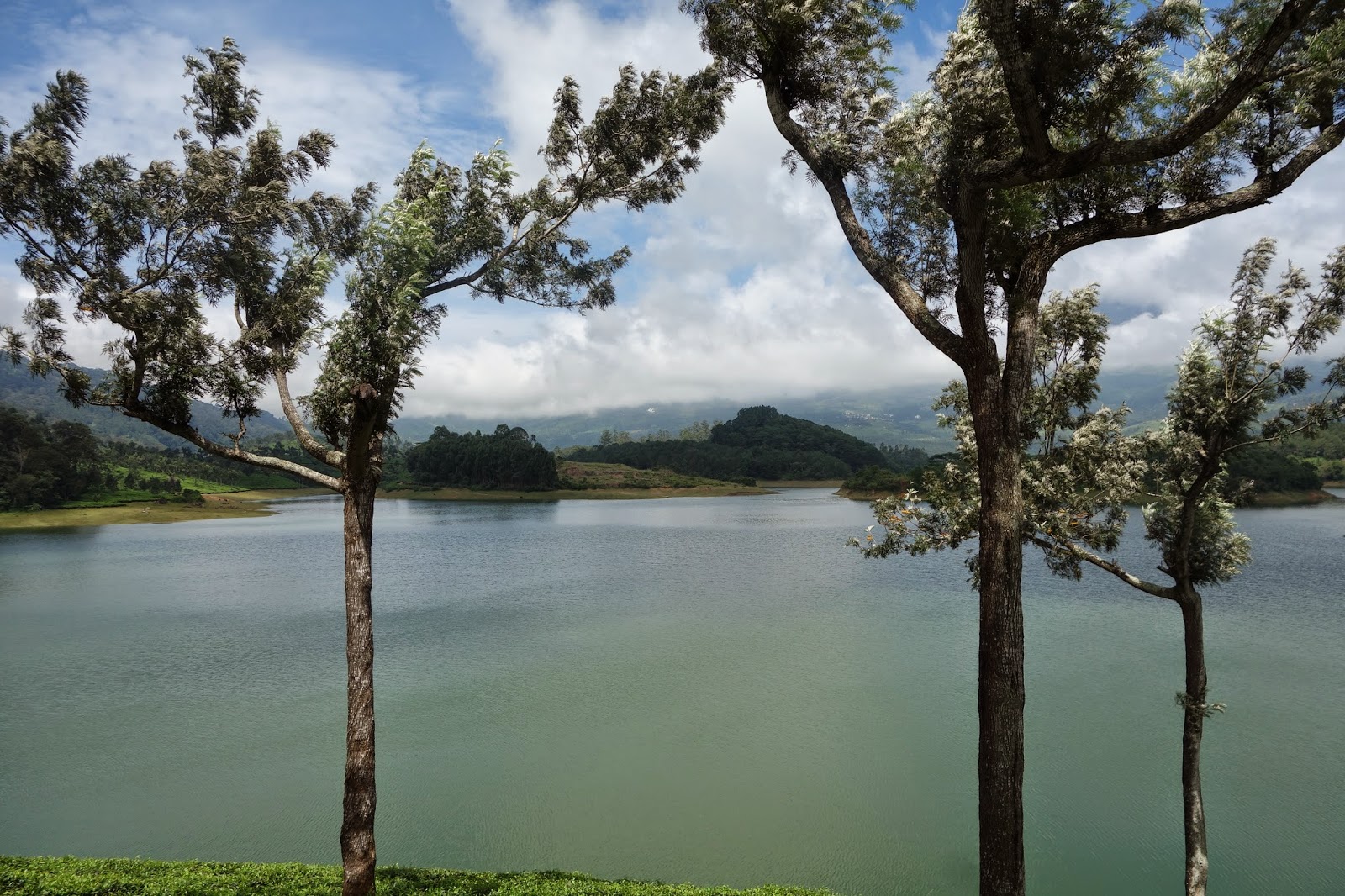
Tea farmers plant silver oaks every few meters as a natural irrigation system. In the rainy season, the roots of the trees soak up water. As the land dries out, the roots release water, and the tea plants gladly soak it up. 


By a happy coincidence, the silver oaks are also quite lovely.

For all its idyllic scenery, the trip to Munnar began with a fair amount of anxiety. Margaret was traveling under an assumed name, so far as her travel documents were concerned. Our friend Dan, meanwhile, checked his bag at the last minute. It contained not only his wallet and passport, but his beloved iPhone, too. So we had a suspenseful wait in line to board our plane, followed by a suspenseful few hours in the air. 

Luckily, all ended well. Apparently it's ok to travel under an assumed name in India, and usually, bags turn up when and where they're supposed to.


It was a five hour drive to Munnar, which we both remember in great detail. There was the moment when a truck emblazoned with "Jesus Christ Will Save You" barreled towards our tiny car.
There was the darkly comic realization that our car had Hindu, Christian, Islamic, and secular spiritual precautions against accidents dangling from its rear-view. There were the skull and cross bones signs, which were, if anything, understatements of the driving conditions.

There was the moment when we turned and saw monkeys, sitting on a wall just off the road.

We have no photographic evidence of any of this.


And then there was arriving in Munnar, when we grudgingly realized that in spite of all our anxiety, and in spite of the impending prospect of driving back on exactly the same road (crossbones and all),  we had landed somewhere wonderful.


In the mornings, there were sunrise runs through the fields of tea, past waterfalls. The air smelled like tea -- fresh, green, and gorgeous. On occasion, there were monkeys playing overhead.

And there was walking, too, through the tea fields and down to the lake, past waterfalls and through jungle-like spice gardens. At all times, we were looking for elephants.


And we found one. A few locals pointed one out to us, saying excitedly "elephant, elephant!" We finally spotted him, his ear twitching on the hillside opposite. He's in this picture, just a shadow in the middle of the treeline!


Despite his attempt at camouflage, this frog was easier to spot.


In the afternoons, Munnar grew warm and foggy and rainy. Inside, listening to the rain fall, we learned a traditional Indian game -- a cross between pool and tiddly-winks. We were terrible at it. For consolation, there was ping pong, and pool, and spades.


Kerala is one of the more Catholic regions of India. There are almost as many churches dotting the countryside as there are temples. (In some cases, we found the churches and temples pretty much indistinguishable.)


It is odd to go someplace to which we will almost surely not return. Perhaps that makes Munnar more memorable -- so visually striking, so bursting with the smell of tea, and so friendly. We will not sip tea in quite the same way for a while. 


And when our current supply runs out, we're already contemplating Lockhart Tea Factory's rather complicated mail-order system.....

Sunday, November 2, 2014

Happy Halloween!


We spent ours at a game night, hosted by a witch and a self-proclaimed "skillington."


We had to leave early, though. There was an aquathlon at Emirate's Palace the next day: an event we've been waiting for since we first laid eyes on Emirate's Palace.

Here we are, first-time aqua-thletes, victorious....


....and fueled by pie.


Friday, October 31, 2014

A Passage to India, volume I: Chennai

We spent our first three days in India in Chennai, the bustling and sprawling capital of Tamil Nadu.


We were nowhere near EM Forster's sound-warping caves, but there were some Forster-worthy miscommunications. Our gracious hosts were so anxious for us to have a good time that we grew anxious that they were over-exerting themselves. Chief among mounting anxieties was the worry (no one will possibly believe this) that we weren't eating enough. They were especially worried (again, we don't expect you to believe this) about Nick.


Believe us, he was eating. For starters, he ate that, in one sitting! And it was amazing. In Chennai, we had the best chana masala, poori, and daal we'd ever tasted. Every day was full of delicious dishes, familiar and unfamiliar. Each and every one of them was rich and incredibly filling.

We had a brief respite from our marathon-like meals over coconut water...


...and while learning to cool hot coffee, Indian style.


On our first full day in Chennai, we wandered through "nearby" Pondicherry, the largest French colony in India. Pondicherry, we discovered is actually pretty distant from Chennai (which was a British trading post for cotton, widely known as Madras).

Pondi, as it's affectionately known, impressed us from the start. Upon getting out of the car, we turned to see an elephant amble down the middle of a street full of parked cars. Unfortunately, we only got pictures of Nick walking down the street. We'll pretend not to be disappointed.


The French quarter is pretty and quaint, with big trees arching over the road, brick-paved streets, and a pretty town square. Street names are all in French, as are the stations of the cross in this lovely Catholic church.


On the way to Pondi, we saw strange things. First example: Oreville, a Utopian town conceived in the 70s, built around meditation inside a golden bean, which apparently holds a large crystal. The town has been slow to spring up (as has the moat promised around the bean), but non-participants can view the bean from afar.


We imagine that more time was spent perfecting the bean than crafting the town's guidelines, which require town citizens to abandon religion, and also to "live freely" under a "single authority." Conduct a few interviews, and we could write the condescending New Yorker piece ourselves.

We also saw wondrous things. (No, the bean didn't really count.) Also on the way to Pondi was Mamallapuram, sprawling stone temples dating from 7th - 9th century.


The temples testified to the booming trade in the region -- we saw Roman columns and Chinese-style pagodas and lions.


This temple, which is one of the largest bas reliefs in the world, was our favorite -- covered in Hindu stories all carved from a single stone.


That little columned temple on the left shelters some rather darling animals. A bull stands strong, his leg jutting out from the rest of the carving.


A mama cleans her baby.


Krishna's Butterball is nearby. The huge stone worried the British so much that they had seven elephants try to dislodge it before it fell on its own.  The elephants couldn't budge it, and it remains perched not-so-precariously on the hill.


We were delighted, after such serious sightseeing so far afield, to spend time in Chennai. The streets are packed -- with cars, with people, with oxen, with food sellers. The bustle was dusty, vibrant, and exhausting. Temples make for a tiny bit of respite at nearly every street corner.


We visited Kapaleeshwarar on a Story Trails tour of Chennai. We were glad to get guidance. We had no idea, for example, that there is a set path through Hindu temples (we wondered in Nepal why we were the only people wandering back and forth), and we didn't realize that the chatting, back-slapping, and eating going on inside is part of usual temple life.


Mothers hoping to conceive, and girls hoping to get married, hang things from this tree. 


Catholicism made it to India early, with St. Thomas, who landed in Kerala and walked across the peninsula to Chennai, spreading the Gospel as he went. He lived in Chennai for some time, and was martyred on a nearby hillside. Today, St. Thomas's Basilica is built around his remains. 

The building is a neo-Gothic birthday cake of a church, ruffled and white. Inside and outside, local symbols and traditions blend with Catholicism. 

Mary graces the courtyard outside, wearing a sari. She gets a change of outfit (and, we hear, color) every day. 


Peacocks, symbols of purity, stand at the foot of the cross; Christ's feet rest on a lotus flower. Outside, flags celebrating the time of year and the religious day are draped on poles like those at Hindu temples.


The Portuguese built the church (they were there ahead of the British), but the British helped rebuild it in the nineteenth century. They already had their own church, inside the fort.

Fort St. George, built to administer the cotton trade and protect the workers of the Dutch East India Company, is now the center of state government. At the heart of the fort is a small Episcopalian chapel. Soldiers, none too experienced at church-building, made it more fortress than church. The ceilings could withstand shelling: they are three meters thick.


Nearby the fort is an even odder remnant of colonial presence: an ice house, built to store ice shipments from the American east coast in the 1830s.


After three days in Chennai, we hopped on SpiceJet to our next stop...Kerala!


Our trip to Chennai was memorable, but in a peculiar way. We were welcomed so graciously and attentively, and we were fascinated by everything we saw. The bustle, the attention, the various pieces of wildly different history, and the driving (oh, the driving) made Chennai memorable, but also disorienting. We could not imagine navigating the city on our own. As we look at our pictures, we see the disorientation we often felt. And we realize that part of the experience that was meaningful for us was the confusion itself. We will have to keep reading and learning to understand even a tiny piece of what we saw.